Discovery of Sally Palmer’s body
The Chemistry of DeathThe discovery of Sally Palmer’s body is the opening rupture in Manham’s seemingly familiar summer: Neil Yates and Sam Yates follow a trail of larvae through the heat and find a dead woman where they expected an ordinary afternoon. The event begins the investigation, draws David Hunter back toward a past he has tried to keep at a distance, and makes the village confront how little it knew about what was happening among its residents.
The trail to the body
The discovery takes place in the second week of July, during a heatwave that has made the ground hard and the vegetation appear drained of colour. Neil, eleven, and his younger brother Sam are walking toward Willow Hole, where they plan to meet friends and swim. Their route takes them along the edge of Farnham Wood, beside the marsh. The oppressive heat and the boys’ impatience make the outing feel routine; neither sets out to find a crime scene.
Sam notices the larvae first. He tends to walk behind Neil, head down, and his hay fever leaves him sniffing through the summer. He stops to examine the line and calls his brother back. The brothers follow it toward the marsh grass from which it emerges. The book explains the trail as part of decomposition: larvae move away from a body, and, in hot, dry conditions, their passage can leave a visible mark on the vegetation. Here, an ordinary biological process becomes the route by which the boys reach the dead.
At the trail’s end they find Sally Palmer’s remains. The condition of the body is so severe that the boys cannot confidently identify the person or even agree afterward on what they saw. The discovery overwhelms their ability to describe it, but they know that the remains are human and that the person is dead. The narrative does not treat their uncertainty as a failure of observation: it shows how shock and the effects of decomposition make an already disturbing encounter difficult to retain as a stable memory.
The boys and the first response
The brothers run home and then make their way to the police station. Neil breaks first, and Sam follows his older brother, as he often does. By the time they reach home, their recollections have already become uncertain. Their mother, Linda Yates, calls David, who is serving as Manham’s doctor. He gives Sam a mild sedative and antihistamine for his hay fever, while Neil, still shaken but beginning to recover his composure, recounts what happened.
Two police officers arrive, but their initial response is unhurried. When one asks which boy will lead them back, Sam buries his head against his mother and Neil pales. David objects to making either child return to the site. The officer instead tells David to guide them, turning the doctor’s local knowledge into a practical obligation. The remains are about three miles away, reached by parking and crossing the marsh toward the woods.
The boys’ discovery thus passes quickly from private shock to official inquiry, but David’s role does not end with escorting the police. After leaving the site, he tries to contain the thoughts it has stirred. At the road back to the village, he changes course and drives to Sally’s farm. That decision, made before he has fully explained it even to himself, begins a chain of choices that affects his own life as well as the case.
Establishing a forensic timeline
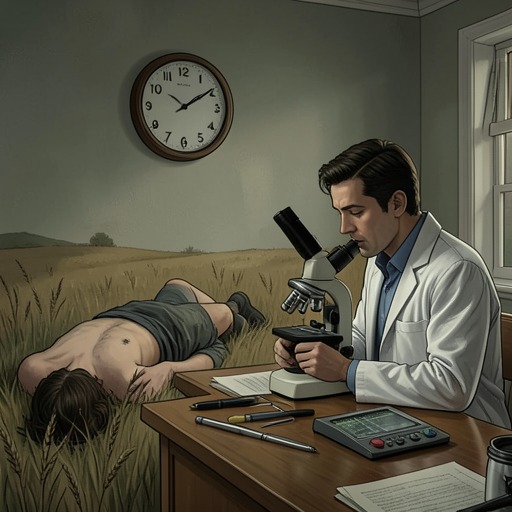
At the scene, David uses insect development and the condition of the surrounding ground to estimate how long the body has been there. Blowflies are among the first insects attracted to open wounds; their eggs can be laid within about an hour in daylight. The age and stage of the larvae, together with the absence of hatched pupal cases, initially support a broad estimate of one to two weeks. David narrows his preliminary best guess to roughly nine or ten days, while emphasizing the uncertainty of making an estimate from a brief examination.
The soil and vegetation provide a second line of evidence. David identifies adipocere, a substance formed as body fat breaks down, and explains that it can make the soil alkaline enough to kill grass. Its brittle, crumbly state is consistent with rapid decomposition in hot weather, while the relatively small amount present also supports a time since death of less than two weeks. These observations turn the scene into a record of the body’s exposure to its surroundings, but they do not, by themselves, establish exactly when or where Sally died.
Later examinations add complications to that first estimate. David argues that the body’s premature drying is consistent with substantial blood loss before death, not merely the post-mortem effect of a cut throat. The soil at the discovery site has low iron content, although a large loss of blood there should have left more. Together, these details support the possibility that Sally was killed elsewhere and brought to Farnham Wood. The place where the boys found her is therefore not necessarily the place where the fatal violence occurred.
Sally’s disappearance and the wider case
The investigation reveals that Sally had not been seen since the pub barbecue. She was expected to collect a grocery order the following day and ordinarily stopped each morning at the newsagent’s for her Guardian, but she did neither. No one reported her missing; people assumed she had gone away or was occupied with writing. The discovery therefore exposes not only a murder but a gap in the village’s attention: Sally could disappear without her absence promptly becoming a communal concern.
The body also becomes part of a developing pattern. Swan wings are found with Sally, and David later connects them with a dead stoat reportedly left on her doorstep and a mallard tied to a stone on the morning Lyn Metcalf disappeared. Mackenzie considers whether the animal remains might be a warning or marker, while recognizing that the evidence does not settle who left them. The discovery consequently marks the first major point at which the investigation can connect a murder scene with recurring signs of deliberate staging.
The book gives the event a double significance. In the immediate sequence, the larvae lead two boys to a body and summon the doctor and police. In retrospect, the scene also reveals a threat that had been present in Manham before anyone knew to look for it. Neil later continues telling the story as the boy whose discovery started the summer’s events, but David’s narration corrects that neat beginning: the discovery did not create the danger. It made visible what had already been living among them.